
Recently, I went to a screening of the movie, Dune 2. I had an opportunity to attend when Javier Bardem would be there have a conversation after we’d seen it. Without his presence I wouldn’t have been interested in getting myself together early on a Sunday morning even for an epic film in a state of the art theater.
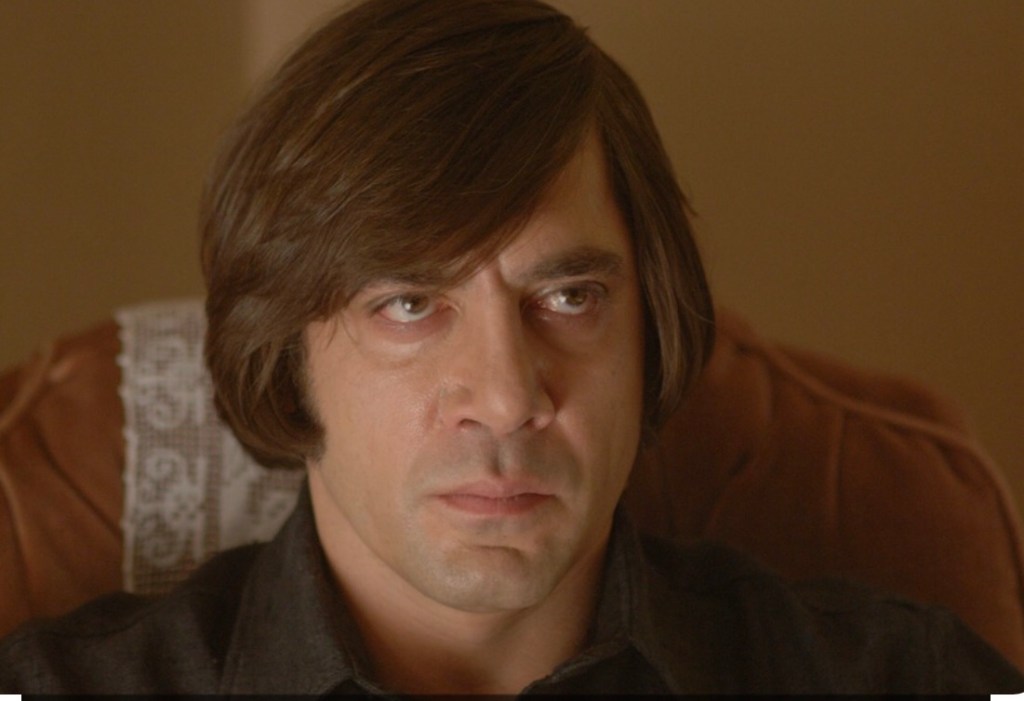
As often happens, the reason I thought I was there, to get some insight about the craft of acting from someone I’ve considered a master at it since his appearance in the Coen Brothers’, No Country for Old Men, 2007. Bardem’s portrayal of the psychopath, Anton Chigurh didn’t just scare me, the character’s implacable machine like propensity to kill rattled primal fear. The movie itself won best picture that year and put the Spain born Bardem on the map as an actor in English language cinema.
Unfortunately, Dune 2’s overblown sense of importance which is magnified by extremely loud bass augmented sound design forgets what Bardem told us yesterday in his talk. Bardem is adept at capturing nuances of evil as witnessed in his work with the Coen Brothers and that same capacity can safely be extended to his 2012, Skyfall portrayal of the madman, Raoul Silva.
In an answer to an audience member’s question he amicably referenced a collaborative effort with Dune director, Denis Villeneuve, to capture the human propensity for humor in dark situations. Bardem can be counted on to use his considerable wit deftly in his work but to trigger that subtle sensorial tickle in the chest that occurs when a dangerous situation is imbued with an actor’s considerable intellect and skill.
However, when Bardem’s character, Stilgar, attempts to insert a moment of transcendence into yet another thundering worm eliciting rhythm to the perpetual wars his people are enduring the tension that surrounds him and is reflected on the faces of much of the rest of the cast constricts instead of amplifies the tone which Stilgar’s supporting cast bounce into the focus of the camera lens. A good laugh breaks into darkness with the power to erase a stilted reality with common sense.
Dune 2 with all it’s seriousness about the life giving essence of water which is so rare as to necessitate certain tribal members appointment as tribal extractors of a the precious substance using tubular objects and needles that they insert in the bodies of living enemies and cadavers alike.
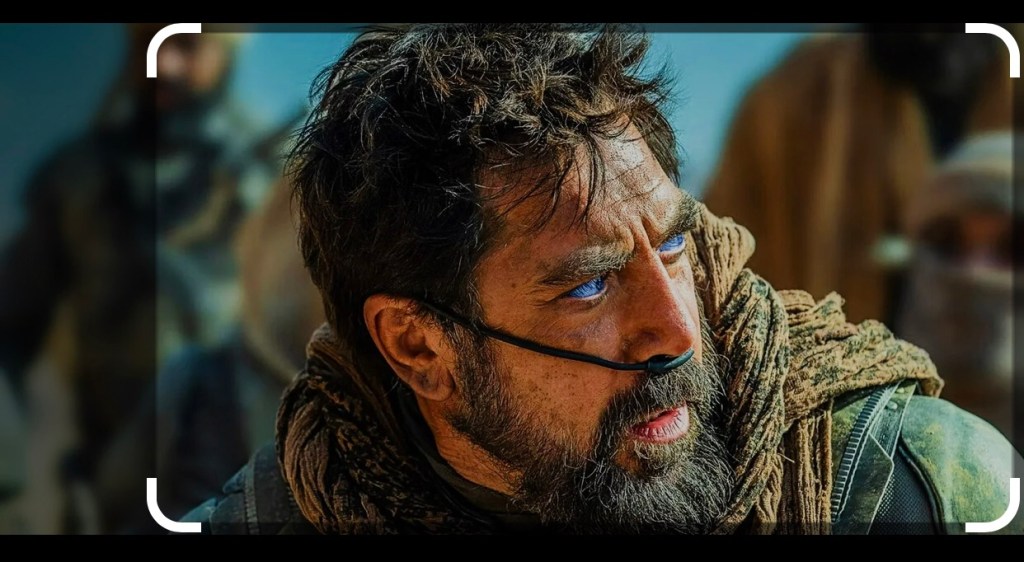
In fact, the overarching theme of Dune 2’s year 10191 plot evolves around the element we take in the 2000s for granted, water. Since scientists have begun to attach a fourth power to H2O by the year of the movie’s release, 2024, what the plot of Dune might have added to Hebert’s story was the fascinatingly mysterious way that water is emerging as a truly mysterious shape-shifting source of contention among theorists and researchers. In a nutshell the fourth power of water transcendes the three we learned about in elementary school. Solid, liquid and gaseous states are familiar and taken for granted. As such the preciousness that water is given in the Dune plot would be much more cogent and effective if this new power, the ability to tunnel through small spaces, very small spaces, with its EZ status, the exclusion state.
Since the Dune universe exists insidie the epitome of grandeur as size the macro aspect of the centerpiece the seemingly endless desert sand dunes of Arrakis which house humongous worms entreated with chariot like service to the tribal lords would give a strong counterpoint to this emerging theory about water’s micro abilities. The contrast might have made the elusiveness of water that the movie struggle to transcribe from the novel to the screen could have been strengthened and made Villaneurve’s remake more engaging because no matter what planet humans inhabi, subliminally we know we need the substance of water. Thus, the world of Dune 2 might have provided Bardem’s talent as well as the rest of the cast with fodder on which to land humor, a much needed fifth element to story, direction, sound design, and cinematography in this two hour and two minute epic.
 LIMIT EXPERIENCE